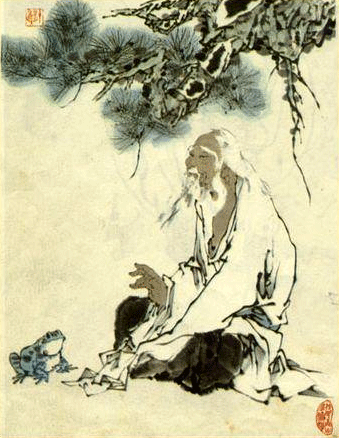
The Art of Yielding: A Path to Preservation
Chuang Tzu's assertion, "To yield is to be preserved," invites us to reconsider our understanding of strength and resilience. In a world that often equates power with rigidity, this profound statement suggests that true preservation lies in the ability to yield, to bend rather than break. This perspective is not merely philosophical; it holds practical significance for our lives, urging us to embrace flexibility as a means of survival and growth.
Yielding, in this context, is not a sign of weakness but rather an expression of wisdom. It challenges the conventional notion that assertiveness and dominance are the only paths to success. Instead, Chuang Tzu encourages us to recognize the strength found in adaptability and surrender, suggesting that by yielding, we can navigate the complexities of life with grace and resilience. This teaching resonates deeply in our contemporary struggles, where the pressures of modern existence often compel us to adopt a more combative stance.
The image / the metaphor
At first glance, the imagery in Chuang Tzu's quote evokes a sense of fluidity and softness. The verb "yield" conjures images of a willow tree swaying in the wind, bending gracefully without breaking. This visual metaphor speaks to the essence of adaptability, where yielding becomes a dynamic process rather than a passive act. The notion of preservation suggests that through this yielding, we not only survive but thrive, maintaining our integrity while navigating the challenges that life presents.
In the speaker's tradition
Chuang Tzu's teachings are deeply rooted in the Taoist tradition, which emphasizes harmony with the Tao, or the fundamental nature of the universe. Central to this philosophy is the concept of wu wei, which advocates for action that is in alignment with the natural order, often achieved through yielding. This idea parallels concepts found in other spiritual traditions, such as kenosis in Christian mysticism, where self-emptying leads to divine fullness, or sunyata in Buddhism, which speaks to the emptiness that allows for true existence.
In the Zhuangzi, the text attributed to Chuang Tzu, we find numerous anecdotes illustrating the power of yielding. One such story involves a skilled butcher who, through his understanding of the natural flow of the animal's body, is able to carve meat with remarkable ease. This narrative serves as a metaphor for life itself, suggesting that when we yield to the inherent rhythms of existence, we can navigate our paths with greater ease and effectiveness. The wisdom of yielding is thus not only a philosophical stance but a practical guide to living harmoniously within the world.
Living the teaching
Consider a modern scenario where this teaching can be applied: the workplace. In a competitive environment, the pressure to assert oneself can be overwhelming. Yet, those who practice yielding—listening actively, collaborating, and adapting to the needs of the team—often find themselves more effective and respected. By yielding to the collective wisdom of the group, individuals can foster a sense of unity and shared purpose, ultimately leading to greater success than a purely combative approach might yield.
In personal relationships, the principle of yielding can transform conflicts into opportunities for deeper understanding. When faced with a disagreement, instead of rigidly holding onto one's perspective, one might choose to yield, to listen, and to empathize with the other person's viewpoint. This act of yielding does not mean abandoning one's beliefs but rather creating space for dialogue and connection. In doing so, relationships can flourish, grounded in mutual respect and understanding.
A reflection
As we contemplate Chuang Tzu's wisdom, we might ask ourselves: In what areas of my life am I holding on too tightly, resisting the natural flow of events? This question invites us to reflect on our own tendencies toward rigidity and control, encouraging us to explore the possibility of yielding as a path to preservation and growth. By embracing this inquiry, we open ourselves to the transformative power of adaptability, allowing the wisdom of yielding to guide us through the complexities of our existence.



Join the BrightStar Community
Stay connected with daily inspiration, event announcements, and community wisdom