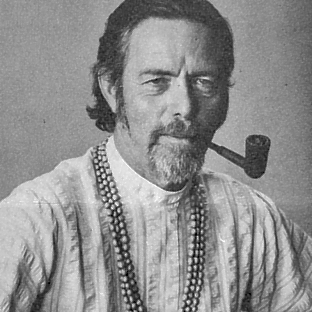
Embracing the Unfathomable: The Wisdom of Losing One's Mind
Alan Watts provocatively asserts that "to go out of your mind at least once a day is tremendously important." This statement invites us to consider the value of stepping outside the confines of our habitual thinking. In a world that often prioritizes rationality and control, Watts encourages us to embrace moments of spontaneity and chaos, suggesting that such experiences can lead to profound insights and a deeper sense of freedom. The stakes are high; in a society that often equates mental stability with success, the act of 'losing one's mind' becomes a radical act of liberation.
To go out of our minds is not merely to lose control; it is an invitation to transcend the limitations of our conditioned thoughts and beliefs. This act can be seen as a form of spiritual practice, a way to reconnect with the essence of our being beyond the incessant chatter of the mind. In doing so, we may discover a more expansive reality, one that is rich with possibility and creativity. Watts's words resonate deeply in our contemporary context, where the pressures of daily life can lead to a disconnection from our true selves.
The image / the metaphor
The imagery in Watts's quote evokes a sense of liberation and playfulness. The phrase "go out of your mind" suggests a departure from the familiar confines of rational thought, akin to stepping outside a locked room into the vastness of the world. The verb "go" implies movement, an active choice to leave behind the habitual patterns that often dictate our lives. This departure is not a reckless abandonment but rather a conscious act of exploration, inviting us to experience life in its fullness.
In the speaker's tradition
Alan Watts's teachings are deeply rooted in Zen philosophy, which emphasizes the importance of direct experience over intellectual understanding. Concepts such as *sunyata* (emptiness) and *prajna* (wisdom) resonate with the idea of going out of one's mind. In Zen, the mind is often viewed as a source of suffering when it clings to fixed ideas and identities. By transcending the mind, we can access a deeper wisdom that is not limited by our thoughts, allowing us to experience the world with fresh eyes.
In his work, Watts often draws upon the teachings of the *Tao Te Ching*, where Lao Tzu speaks of the importance of embracing the natural flow of life. The idea of *wu wei*, or effortless action, parallels Watts's assertion that losing our minds can lead to a more authentic way of being. When we let go of our rigid mental frameworks, we align ourselves with the rhythm of existence, moving fluidly through life rather than resisting it. This alignment fosters a sense of peace and connection to the world around us.
Living the teaching
Consider a modern scenario where the pressures of work and daily responsibilities weigh heavily on an individual. In this context, the idea of going out of one's mind may manifest as a spontaneous decision to take a break from routine—perhaps a walk in nature or an impromptu gathering with friends. Such moments of departure from the ordinary can serve as a reminder of the joy and spontaneity that life offers, allowing for a reconnection with one's inner self. This practice of stepping away from the mind's incessant demands can lead to renewed clarity and inspiration.
In relationships, the teaching of losing one's mind can also find expression. Imagine a couple caught in a cycle of conflict, where each partner is entrenched in their perspectives. By consciously choosing to "go out of their minds," they might engage in a playful activity together, such as dancing or creating art. This shift in focus allows them to transcend their disagreements, fostering a deeper connection and understanding. In these moments, the rigid boundaries of the mind dissolve, revealing the underlying love and compassion that often gets obscured by conflict.
A reflection
As we contemplate Watts's assertion, we might ask ourselves: What would it mean for me to go out of my mind today? This question invites us to explore the boundaries of our thoughts and beliefs, encouraging us to seek moments of spontaneity and freedom. In a world that often prioritizes control and predictability, the act of losing our minds can become a profound spiritual practice, leading us to a deeper understanding of ourselves and our place in the universe.



Join the BrightStar Community
Stay connected with daily inspiration, event announcements, and community wisdom