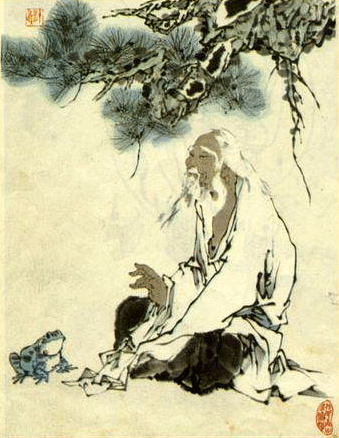
Embracing the World: The Sage's Journey
Chuang Tzu's assertion that "He goes everywhere and is at home everywhere" invites us to contemplate the nature of belonging and the essence of the sage. This profound statement suggests a fluidity of existence, where the sage transcends the confines of physical location and emotional attachment. It challenges us to consider what it means to truly belong, not just to a place or a community, but to the very fabric of life itself. In a world often marked by division and isolation, this teaching beckons us to explore a deeper sense of connection and presence.
At its core, this quote speaks to the idea of being at peace within oneself, regardless of external circumstances. It encourages us to cultivate an inner sanctuary that allows us to navigate the complexities of life with grace and ease. The sage, as depicted by Chuang Tzu, embodies a state of being that is both grounded and expansive, suggesting that true belonging is not tied to a specific location but rather to an inner state of harmony. This perspective invites us to reflect on our own lives and the ways we seek connection, urging us to find our place in the world through acceptance and understanding.
The image / the metaphor
The imagery within Chuang Tzu's quote evokes a sense of boundless freedom and adaptability. The phrase "goes everywhere" conjures an image of a traveler, unencumbered by the weight of possessions or the constraints of societal expectations. This traveler embodies a spirit of exploration, moving through various landscapes and experiences with ease. The second part of the quote, "is at home everywhere," suggests a profound inner peace that allows the sage to feel a sense of belonging no matter the external circumstances. This duality of movement and stillness encapsulates the essence of the sage's journey.
In the speaker's tradition
Chuang Tzu's teachings are deeply embedded within the Taoist tradition, which emphasizes the importance of living in accordance with the Tao, or the Way. This concept of the Tao reflects the natural order of the universe, suggesting that true wisdom lies in aligning oneself with this flow. The sage, as portrayed by Chuang Tzu, embodies the principle of wu wei, or effortless action, allowing life to unfold without resistance. This state of being resonates with the idea of sunyata, or emptiness, found in Buddhist philosophy, where the absence of rigid identity allows for a more profound connection to the world.
In the Zhuangzi, the text attributed to Chuang Tzu, we find numerous anecdotes that illustrate the sage's relationship with the world. One such story involves a fish that is caught and then released, symbolizing the importance of freedom and the ability to navigate life's challenges without attachment. This narrative echoes the sentiment of being "at home everywhere," as it highlights the sage's ability to adapt and find peace in any situation. By embracing the fluidity of existence, the sage teaches us that belonging is not a destination but a journey of self-discovery and acceptance.
Living the teaching
Consider a modern scenario where this teaching might resonate: a person relocating to a new city for work. Initially, they may feel disoriented and disconnected, grappling with feelings of loneliness and uncertainty. However, by embodying the essence of Chuang Tzu's wisdom, they can cultivate a sense of belonging that transcends their physical environment. By engaging with the community, exploring local culture, and embracing new experiences, they can find a sense of home within themselves, regardless of their surroundings. This journey illustrates how the sage's perspective can transform feelings of isolation into opportunities for growth and connection.
In relationships, the teaching of being "at home everywhere" can also manifest in profound ways. Imagine a conflict arising between two friends, where misunderstandings create distance. By approaching the situation with the sage's mindset, one can cultivate empathy and understanding, recognizing that true belonging comes from a place of acceptance and compassion. Instead of clinging to grievances, the individuals can navigate their differences with grace, finding common ground and fostering a deeper connection. This application of Chuang Tzu's wisdom highlights the transformative power of embracing the world with an open heart.
A reflection
As we reflect on Chuang Tzu's insightful words, we are invited to consider our own relationship with belonging. In what ways do we seek to find home within ourselves and the world around us? Are there areas of our lives where we feel disconnected or out of place? By contemplating these questions, we can begin to explore the deeper layers of our existence, embracing the journey of becoming at home everywhere we go. This inquiry not only enriches our understanding of ourselves but also deepens our connection to the world and the people we encounter along the way.




Join the BrightStar Community
Stay connected with daily inspiration, event announcements, and community wisdom