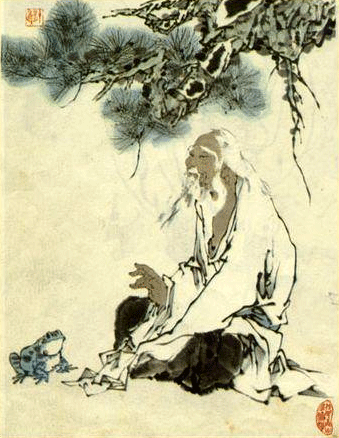
The Serenity of Emptiness: Chuang Tzu's Vision of Stillness
Chuang Tzu invites us into a profound understanding of existence with his assertion that "vacancy, stillness, placidity, tastelessness, quietude, silence, and non-action" represent the essence of heaven and earth. This statement challenges our conventional notions of fulfillment and success, suggesting that true harmony lies not in action or accumulation, but in the embrace of emptiness and stillness. In a world that often equates busyness with productivity, this perspective offers a radical reorientation toward a more contemplative way of being.
In this light, Chuang Tzu's words resonate deeply with the human experience of seeking peace amidst chaos. They remind us that the incessant noise of our lives can obscure the deeper truths of existence. By advocating for a state of non-action and quietude, Chuang Tzu beckons us to explore the transformative power of stillness, encouraging us to cultivate a space where we can connect with the essence of life itself. This exploration is not merely philosophical; it is a call to embody a way of living that honors the profound simplicity of being.
The image / the metaphor
The imagery in Chuang Tzu's quote evokes a landscape of tranquility, where the absence of noise and distraction allows for a deeper connection with the world. Words like "vacancy" and "silence" conjure a sense of spaciousness, inviting us to consider the beauty of what is not present. This felt sense of stillness is not an absence of life but rather a fertile ground from which all things emerge. It suggests that in the quietude of our minds and hearts, we can access a deeper wisdom that transcends the clamor of daily existence.
Diving deeper into the metaphor, we find that "non-action" does not imply passivity or lethargy; rather, it speaks to a state of being that is aligned with the natural flow of life. This concept, known as wu wei in Taoism, encourages us to act in harmony with the rhythms of the universe rather than against them. In this way, Chuang Tzu's vision of stillness becomes a dynamic force, one that allows us to engage with the world from a place of clarity and intention, rather than reaction and noise.
In the speaker's tradition
Chuang Tzu's teachings are deeply rooted in the Taoist tradition, which emphasizes the importance of aligning oneself with the Tao, or the fundamental nature of the universe. This alignment often involves concepts such as sunyata, or emptiness, which suggests that true understanding arises from recognizing the impermanence and interdependence of all things. In this context, the stillness that Chuang Tzu speaks of can be seen as a pathway to realizing one's true nature, free from the distractions of ego and desire.
Moreover, the idea of non-action resonates with the Buddhist concept of kenosis, which refers to the self-emptying of one's will and desires to allow for a greater presence of the divine or the true self. In the Zhuangzi, Chuang Tzu illustrates this through various parables, such as the story of the butterfly dream, where the boundaries between self and other dissolve, revealing the interconnectedness of all existence. This narrative invites us to reflect on our own experiences of identity and separation, urging us to embrace the stillness that allows for a deeper connection with the world around us.
Living the teaching
Consider a modern scenario where the teachings of Chuang Tzu might resonate: a busy professional overwhelmed by deadlines and expectations. In this context, the invitation to embrace stillness and non-action can feel counterintuitive. Yet, by taking moments throughout the day to pause, breathe, and cultivate a sense of quietude, this individual may find clarity and renewed energy. Such practices can transform the experience of stress into one of presence, allowing for more thoughtful and intentional responses to challenges.
In relationships, the application of Chuang Tzu's wisdom can be equally profound. Imagine a moment of conflict where emotions run high, and words are exchanged in haste. By choosing to embody stillness, one partner can create a space for reflection rather than reaction, allowing for a deeper understanding of the underlying issues. This practice of non-action—of holding space for silence—can foster connection and healing, illustrating how the teachings of stillness can enrich our interactions and deepen our bonds with others.
A reflection
As we contemplate Chuang Tzu's assertion that "vacancy, stillness, placidity, tastelessness, quietude, silence, and non-action" embody the essence of heaven and earth, we are invited to reflect on our own lives. What does it mean for us to embrace stillness amidst the noise of our daily existence? In what ways can we cultivate a deeper sense of quietude, allowing it to guide our actions and interactions? These questions invite us to explore the transformative power of emptiness and stillness, encouraging us to find our own level of harmony within the chaos of life.



Join the BrightStar Community
Stay connected with daily inspiration, event announcements, and community wisdom